Professor Laura de Lorenzis
To Be Confirmed

To Be Confirmed
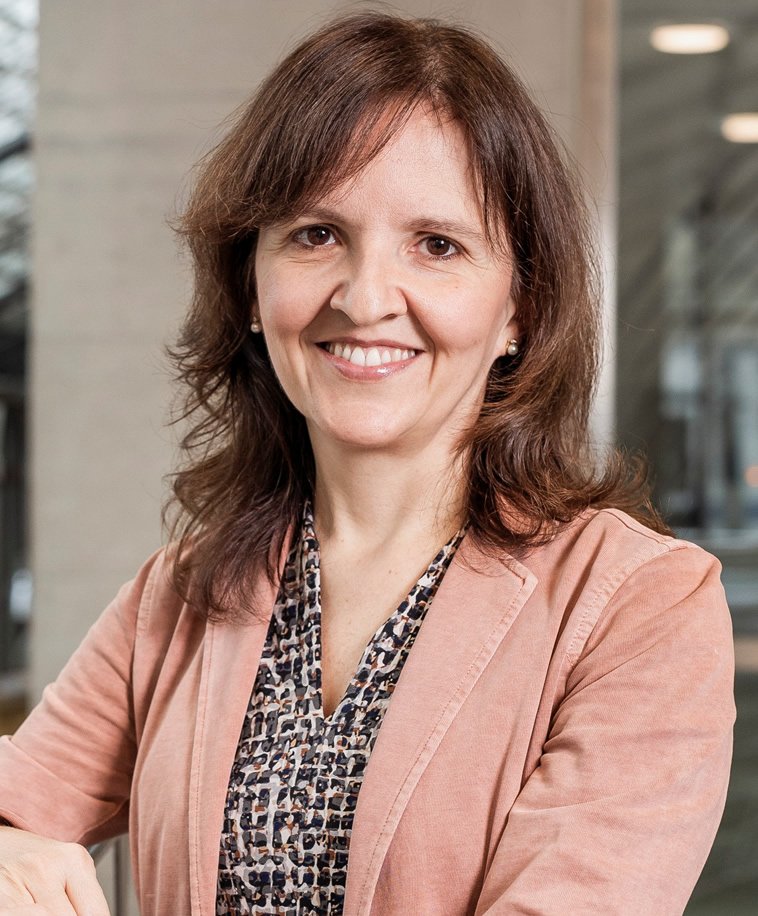
Professor Laura De Lorenzis received her Engineering degree and her PhD from the University of her hometown Lecce, in southern Italy, where she first stayed as Assistant and later as Associate Professor of Solid and structural mechanics.
In 2013 she moved to the TU Braunschweig, Germany, as Professor and Director of the Institute of Applied Mechanics. There she was founding member and first Chair (2017-2020) of the Center for Mechanics, Uncertainty and Simulation in Engineering.
Since 2020 she is Professor of Computational Mechanics at ETH Zürich, in the Department of Mechanical and Process Engineering. She was visiting scholar in several renowned institutions, including Chalmers University of Technology, the Hong Kong Polytechnic University, the Massachusetts Institute of Technology (as holder of a Fulbright Fellowship in 2006), the Leibniz University of Hannover (with an Alexander von Humboldt Fellowship in 2010-2011), the University of Texas at Austin and the University of Cape Town.
She is the recipient of several prizes, including the RILEM L’Hermite Medal 2011, the AIMETA Junior Prize 2011, the IIFC Young Investigator Award 2012, the Euromech Solid Mechanics Fellowship 2022, the IACM Fellowship 2024, two best paper awards and two student teaching prizes. In 2011 she was awarded a European Research Council Starting Researcher Grant.
She has authored or co-authored more than 150 papers on international journals on different topics of computational and applied mechanics. Since 2023 she is Editor of Computer Methods in Applied Mechanics and Engineering.
(joint work with Sepehr Mousavi, Aryan Sinha, Manav Manav, and Siddhartha Mishra)
Neural operators have emerged as powerful surrogates for PDEs, but their application to solid mechanics is often limited by difficulties in handling complex and highly variable boundary conditions, and their use in challenging problems such as damage and fracture remains at an early stage. This presentation first introduces a general framework for conditioning neural operators on arbitrary boundary functions through learned boundary-to-domain extensions, enabling standard architectures to robustly incorporate rich boundary information without PDE-specific modifications and achieving state-of-the-art accuracy, robustness to noise, and strong transferability across linear and nonlinear benchmark problems. It then presents neural-operator-based surrogates for accelerating brittle fracture simulations based on the phase-field approach, accurately predicting crack nucleation, propagation, and branching. Together, these advances demonstrate how modern neural operator methodologies can deliver accurate, efficient, and scalable surrogate models for challenging solid mechanics applications.